Friday, October 4, 2013

The Declutterer's Dilemma: When to Donate? When to Sell?


The more I ditch, the more I realize this is not just about a book here, an old scarf there.  I would honestly like to be rid of more than half the things I own!

It's not only that it feels like clutter; it doesn't even feel like me -- not the present-day me anyway.   I would not choose to purchase (or save) any of these possessions now but they're also very hard to part with.  I don't (like to) think these items are keeping me anchored in the past, but who knows: two decades-worth of old journals, a box of old letters, another of old photos.  Am I going to drag these things with me for the rest of my life?

If, say, they were lost in a fire, how devastated would I be?  Or would I feel relieved?

Then there are those items that I could sell.  The donate vs. sell conflict is a big one for me.  On the one hand, it would feel like a wonderful gift to myself not to have to invest the time and effort to photograph, list on eBay, box, and ship all the things I'd like to be rid of (even Craigslist can be a hassle and it's not a great place to sell small items like, say, sunglasses) -- but do I deserve it? 

On the other hand, who wouldn't like a little extra cash for items there's clearly a market for?

I'm looking at you, Patti Playpal!

I found some interesting websites discussing these very issues (the comments tend to be more interesting than the articles themselves, so check them out too), here and here.  I'm not the only one dealing with the clutter conundrum.

We live in a culture that is obsessed with the cash value of things: think Antiques Roadshow and Storage Wars.  Auction sites like eBay allow us to check what people are willing to pay for almost anything we own and then to sell it ourselves; we no longer have to resort to garage sales or consignment shops.  Even old books can be sold on Amazon (Michael did this just this week, ka-ching).

Decluttering raises a lot of interesting questions about one's relationship to both stuff and money, as well as to time.  It can force you to examine beliefs you may have inherited from parents -- if your parents were raised during the Great Depression, they may have experienced privation firsthand and passed down a fear of not enough-ness that doesn't reflect your life today.  On the other hand, fear of a sudden loss in the value of your national currency might cause you to hoard things -- and who's to say that might not be a good idea?

Today, I had to make a decision about that blue plush peacoat (modeled up top and below) I found last year at the Salvation Army for, like $5.99, and which Cathy wore last winter in her pink hair photoshoot.


I thought about listing it on eBay -- it's vintage, it clean, it's cute.  But instead I brought it back to the Salvation Army.  It just seems like too much trouble to sell clothes online, unless it's like, an original Courrèges. 

Meanwhile, I dumped a few more things today: a big bag of fabric, more books, clean cotton underwear with too much Spandex to be comfortable. (Since I've started sewing boxers, I feel like I'm suffocating in stretch cotton briefs.)


In closing, readers, when you declutter/downsize/simplify, how do you decide what gets donated and what gets sold?

Do you ever feel pressure -- or give pressure -- to sell something for money rather than just give it away?

Could you -- and this is a big issue for me -- forgive yourself if you later regretted the choice you'd made to give away something if, at some future time, you might need the money?

So much to think about.  Maybe over a glass of wine.

Have a great day, everybody!

Thursday, October 3, 2013

Thursday Ditch and B*tch


Thursday and still ditching.  Not the most productive day of my life, but not the least either.  Plus, who says you always have to be productive?

I managed to rid myself of a few more things, including a pair of worn out Keen sandals that may have a bit of life left in them (I'll let the Salvation Army decide) and a weird polyfleece hat/shell thing I think was designed to be worn under a helmet.  I haven't worn it in years so out it goes.  (Plus I no longer wear black.)


Meanwhile, I was curious about the insides of the Brother VX-1120 I found yesterday, so I unscrewed the visible screws and removed the plastic front.  I'm not even sure if you can dismantle most low-end sewing machines these days.


It was sort of sad to examine the inside because it looked so cheap.  As you can see, there's some metal in there but an awful lot of plastic too.


I oiled the moving parts (with the exception of the belt area of course) in hopes I could get the thing to engage just a bit more smoothly.  I also cleaned the entire bobbin area, which had fuzz in it.


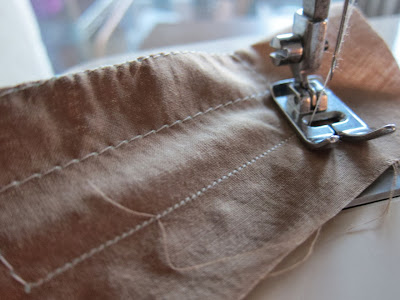
Then I put it all back together.  This amount of cleaning and oiling would make a huge difference in a vintage metal Singer, but in this Brother, it made no discernible difference at all.  My biggest gripe with this machine, as well as other new(ish) plastic sewing machines I've sewn on, is 1) how roughly they start and 2) how stiffly the handwheel turns.

1) With cheap (or poorly maintained) machines, there's often that moment where you half step down on the pedal and you hear the motor engage, but the needle doesn't start moving right away; there's a delay.  It's hard to sew a single stitch, or to backstitch with full control.  If you've ever sewn with a Singer Featherweight, in contrast, the start-up is very smooth and nearly silent.

2) Sewing machine handwheels got small in the mid Sixties (I blame the Europeans) and they're still small.  Once you get used to handling a black Singer's beautiful metal handwheel, which moves so smoothly and is so perfectly balanced, even the handwheel on a Bernina 930 feels too stiff and too shallow (like it wasn't meant to be handled very often, or functionality lost out to sleek design).

My best mechanical machines (and the ones I use most frequently) give me a feeling of absolute control over every stitch.  There is no sudden start up or racing; when the motor engages, the machine immediately starts sewing as quickly or as slowly as you want.  If you can't easily sew one single stitch and just one stitch, then you don't have full control over your sewing.  Sometimes that one extra stitch can take you off the edge of your fabric, or spoil a perfectly topstitched pocket or collar.


I couldn't tell you what it is that makes some motors smooth and some motors rough, but clearly much of it has to do with the quality of the materials.  Those old vintage Singers and Kenmores (among other great old brands) were silky smooth and had big, often very powerful, motors.  Of course, those old metal machines were also heavy.  Plastic is light, making many new machines very portable.  Even the machines that were considered portable in their day were about as light as those portable television sets from the 1950's, i.e, you could carry them from one room to another, but you wouldn't want to go much farther than that.


In closing, I bought another Brother pedal for $15 because if I want to give the machine to someone, I want the machine to be complete.  How would you like someone to give you, say, a kitchen appliance without its power cord (but with instructions on where you could buy one)?  Not very classy if you ask me.

Anyway, it's time to get back to work.

Have a great day, everybody!

Wednesday, October 2, 2013

One Step Forward, Two Steps Back or "Curbside Sewing Machine SCORE!"


Day 3 of ditching and I've experienced a setback, readers!

I'm coming back from the chiropractor this afternoon -- and if you're looking for one in NYC, mine is fabulous -- and am walking west on the south side of 25th Street when I see, across the street, directly outside The City Quilter, a woman carrying away a box she seems to have fished out of their trash (Wednesday must be trash night).  It looks like a sewing machine box so, naturally, I'm intrigued.  I quickly cross the street and approach the remaining trash pile, where I spot another box -- the one pictured above (and below).


I open the box and see that it indeed contains a Brother VX-1120 sewing machine, only it's missing its cord and pedal.  But when I look at the socket, it looks exactly like the one on my Brother 1034D serger.  Might this model use the same pedal/plug?

So I carry it home, take it out of its box (it even has its original styrofoam packaging) and plug my serger pedal into it.  It fits perfectly!


I plug it in; the light turns on.  I press the pedal; the needle moves!  I thread it (I can pretty much thread any standard sewing machine blindfolded) and check the bobbin: it's all there.  With some minor adjusting I balance the thread tension.  It works perfectly.


There is nothing fancy about the Brother VX-1120; it is as basic as they come -- or rather, came, since this machine dates from 1998 (based on the date on the box).  But it has some nice features.  First, the needle position is adjustable (left, middle, right).


It has an amazing range of stitch lengths and the smallest stitches are, frankly, fantastic looking (it's not like the contemporary low-end Brothers that offer only a small number of pre-set stitch lengths.


This would be a great starter machine.  You can buy the cord/pedal combo on eBay for roughly $20.  I may pick one up tonight.  Even better, Brother still offers a free, downloadable PDF of the original manual on their website.  Thank you, Brother!

The VX-1120 is a free-arm (like most modern plastic machines) and very light to carry -- a big plus.  The base contains a space for accessories, which include a zipper foot, three plastic Class 15 bobbins, a feed dog cover, Organ needles and even a double needle -- everything it originally came with, which suggests this machine was lightly used if at all. 


Do you know this is the fourth sewing machine I have found, literally, on the street?

Now wait -- I DID ditch a bit today, pitching a somewhat holey cashmere men's sweater I found not a week ago in the trash, so I'm still on track, right? 

Only, I also bought a book today.

I had coffee with Suzanne (who had the audacity to stop blogging so she could devote more time to her young daughter -- the nerve), and afterwards I stopped into Kinokuniya, the Japanese bookstore we visit every MPB Day.  After eyeing it for literally years, I finally treated myself to a copy of....I don't even know what it's called since I can't read Japanese.  Let's just call it, "The Japanese Men's Coat Pattern Book."


This book includes some fabulous traceable coat patterns, and if you're a fan of Mainely Dad, you know that he has sewn them all and now boasts the most amazing men's outerwear wardrobe north of Portland.  (A direct quote from Mainely Dad/Duane: "...there are 13 coats featured, but they're really just themes and variations on 4 basic patterns.")


Anyway, I think I'm ready to tackle some of these patterns myself and I may pick Duane's brain before I do.


Now you may be wondering how I intend to use a book whose directions are written entirely in Japanese.  That's a very good question for which I should have an answer after I've picked Duane's brain. 


In closing, today's total is not very inspiring: 1 sweater out; 1 sewing machine and 1 book in.

I hope to make up for it tomorrow, I promise!

(Would YOU have left that Brother VX-1120 in the trash?  Be honest.)

Have a great day, everybody!

Tuesday, October 1, 2013

Out With the Old, In With the New???


Tuesday -- Day 2 -- and the ditching continues.

This oversized black hat makes me look like a guy who might sell you camera equipment at B&H Photo, let's leave it at that.  Off to the Salvation Army it goes! 

Here's another hat -- these straw summer hats were all the rage for a while and maybe they still are.  This one never fit.  Ditch!


I was very excited to find the shirt below just around the time I started sewing.  It's quite snazzy for a rodeo or a community theater production of Oklahoma! or Whoop-Up but it's just not me (not to mention the color washes me out). 


It's really sad  --  yet instructive (for those who care to learn) -- that so many of my ditches are returning to the very place I found them.

Why did I bring this striped fabric home from the MPB Day pattern/fabric swap?  It's getting dumped and please don't tell Michael, who chose it.  It's too loud, too thin, and too stretchy to bother with.


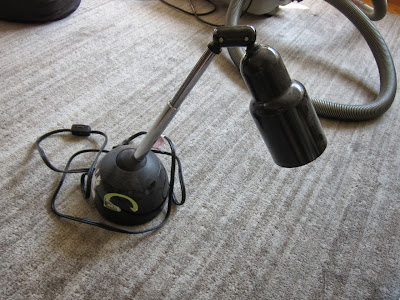
Remember this Ott Light I found at the Salvation Army not half a year ago?  The base is too wide and the light too narrow; I don't use it.  Out it goes -- actually, I may leave this one by the dumpsters as someone's sure to pick it up and it's rather heavy to lug.


Who doesn't own a scratched teflon pan like the one below?  We have a perfectly good cast iron skillet that does eggs even better, with just a little bit more pre-heating and added butter -- nothing wrong with that.  Ditch!


Tuesday's Ditch Total:  1 plastic grocery bag and assorted other stuff, not bagged.


Friends, I want to be clear about something: not all of us are ready to throw bags of stuff out at the beginning of our decluttering/healing process.  Sometimes all we can manage is to pitch an expired bottle of Iboprofen and that's OK.  The important thing is that you ditch daily, even if it's only one little thing.

Naturally, as we get closer to what feels like "muscle" (as opposed to fat) it's going to get harder to ditch.  I'm already eyeing my sewing machine collection.  Do I really need a white Featherweight when I have two (or was it three) black ones?  If Michael doesn't feel any sentimental attachment to his mother's 35 lb. Kenmore, would it be inappropriate to get rid of it?  I mean, it's a boat.  These are all questions I'm going to have to answer myself with perhaps a little advice from the peanut gallery. (OMG, I just learned this term had nothing to do with Charles Schultz: I've spent my entire life saying Peanuts gallery.)

Moving onto In with the new, if there is a downside to the Mood Sewing Network, it is that I am obligated to buy fabric every month, regardless of my state of mind or the (currently sorry) state of my apartment.  Today I picked up fabric for a (likely) October project. 

One of my challenges as the lone male in this group of gals is that men's clothes are largely predictable (at least the kind I wear) -- pants, shirts, jackets, etc., made from the same types of fabrics -- so I feel the need to make lots of individual garments.  Like, it's not enough for me to just sew a cotton shirt; I need to sew a shirt and pants, or a jacket and shorts ensemble -- you get the idea.  Plus a little Cathy thrown in to liven things up.

For October, I'm planning a sweater-shirt-pants ensemble, made of the following fabrics, respectively:

This cement gray wool knit (which may or may not be a vest combining the knit and some other fabric):


This black and white gingham shirting:


This mustard yellow Marc Jacobs cotton twill:


I also looked at the considerably brighter Rag & Bone twill below, but I was afraid it was just too bright.  Now I'm not so sure.  Was I right to pass on the French's mustard and go for the spicy brown Gulden's?


Reader's that all for today -- I have bags to unload at the thrift store, fabric to preshrink, and dogs to walk.

Have a great day, everybody!

PS -- How's your ditching going?